

Here’s something I see constantly in Australian e-commerce Facebook groups: a store owner posts their returns policy and someone replies, “mate, that ‘no refunds’ clause is illegal.” The store owner is shocked. They copied it from a template they found online. They had no idea.
If that story sounds familiar, this guide is for you. Under the Competition and Consumer Act 2010 (Cth) Schedule 2 — known as the Australian Consumer Law (ACL) — displaying a “no refunds” sign or policy is not just bad practice, it is a criminal offence. And yes, it applies to your online store, whether you’re based in Sydney, Singapore, or anywhere else, if you sell to Australian consumers.
In this guide I’ll walk you through exactly what the ACL requires, what you must display on your store, and — because I know you came here for something actionable — I’ve included a copy-paste ACL-compliant returns policy template you can drop into Shopify right now. Let’s get into it.
What Is Australian Consumer Law and Does It Apply to Your Online Store?
The ACL is a single national law that replaced a patchwork of state-based consumer protection laws in 2011. It is enforced by the Australian Competition and Consumer Commission (ACCC) at the federal level and by each state’s fair trading office at the local level.
Here’s the critical point, stated once and clearly: if you sell goods or services to consumers in Australia, the ACL applies to you — regardless of whether your warehouse is in Melbourne or Manila. A Shopify dropshipper sourcing from China but marketing to Australian buyers is fully within ACL scope. A SaaS company with servers in Ireland selling subscriptions to Australian businesses is covered too.
The law creates automatic “consumer guarantees” — a set of baseline rights that cannot be waived by contract, terms of service, or any policy you write. They exist by force of statute. You cannot contract out of them.
Consumer Guarantees: The Non-Negotiable Baseline
Consumer guarantees under the ACL (Part 3-2) cover goods and services sold to consumers — defined as purchases under $100,000 AUD, or goods ordinarily acquired for personal, domestic, or household use regardless of price. The key guarantees for product-based online stores are:
- Acceptable quality — goods must be safe, durable, free from defects, and acceptable in appearance and finish
- Fit for disclosed purpose — if a customer tells you what they need it for and you confirm it will work, it must
- Match description — product listings, titles, and descriptions are legally binding representations
- Match sample or demonstration model — if you show a sample, the delivered product must match it
- Right to repair, replacement, or refund — the remedy depends on the severity of the failure
- Spare parts and repair facilities — for a reasonable period after purchase (more on this below for electronics dropshippers)
For services, the guarantees include being rendered with due care and skill, being fit for purpose, and being delivered within a reasonable time if no date was specified.
ACL Refunds Online: Minor Failures vs. Major Failures
Not every fault triggers a full refund. The ACL distinguishes between minor and major failures, and the distinction changes the remedy entirely.
Minor Failures
A minor failure is one that can be fixed. Think: a small cosmetic scratch, a missing button that can be replaced, a software bug with a patch available. For minor failures, the business chooses the remedy — repair, replacement, or refund. You are not obligated to offer an immediate refund for a minor fault.
You must, however, provide the remedy within a reasonable time. Stalling for weeks to avoid a refund is not compliant.
Major Failures
A major failure is one where the product:
- Would not have been bought had the consumer known about the problem
- Is significantly different from the description, sample, or demonstration
- Is substantially unfit for its purpose and cannot be fixed quickly
- Creates an unsafe situation
For a major failure, the consumer chooses the remedy — not you. They can demand a full refund, a replacement, or compensation for the drop in value. You cannot insist on repair only.
Two-Step Shopify Partial Refund Workflow for Major Failures
When a major failure results in a partial refund (e.g., the customer keeps the product but seeks compensation for reduced value), here’s exactly how to process it in Shopify:
- Go to Orders → open the relevant order → click Refund
- Set the quantity to refund to 0 (no items returned), enter the partial dollar amount in the “Refund amount” field manually, add an internal note (“ACL major failure — partial compensation”), then click Refund
This creates a paper trail in your order history without triggering a return merchandise authorisation. Keep a record of your communications with the customer — the ACCC recommends maintaining dispute records for at least two years.

Online Store Returns Policy Australia: What You Cannot Say
The ACCC is explicit on this. Under Section 29 of the ACL, it is illegal to make a false or misleading representation about consumer rights. The following statements are illegal in your returns policy:
- “No refunds”
- “No refunds on sale items”
- “Exchange or store credit only”
- “We do not accept returns after 30 days” (if the fault was present at purchase)
- “Warranty void if seal broken” (if breaking the seal is necessary to use the product)
- “Your statutory rights are not affected” alone is not enough — you must actively describe those rights
Penalties for misleading representations can reach $50,000 per contravention for individuals and $250,000 for companies under the ACL. Enforcement actions by the ACCC are public and named. This is not theoretical risk.
Change of Mind Returns — What ACL Actually Says
Here’s the nuance most guides get wrong: the ACL does not require you to accept change-of-mind returns. Consumer guarantees only apply to faults, not buyer’s remorse. You can legally have a “no change-of-mind returns” policy — but you must make this clearly visible before purchase, and it must be separate from your ACL fault remedy policy.
Many stores offer change-of-mind returns as a competitive differentiator (think Kogan’s 30-day returns). That’s your call. Just never conflate your voluntary change-of-mind policy with ACL-mandated fault remedies in the same paragraph — it confuses customers and potentially misleads them about their actual rights.
BNPL Warning: Afterpay and Zip Change-of-Mind Disputes
If your store accepts Afterpay, Zip, or Klarna, pay attention here. When a customer raises a change-of-mind dispute through the BNPL provider’s platform rather than through your store, some providers will pause future instalments automatically while the dispute is open — even if your policy clearly states no change-of-mind returns. This can trigger chargebacks outside your normal flow.
Best practice: add a line to your returns policy specifically stating that BNPL disputes for change-of-mind returns are governed by your store policy (no return accepted), and direct customers to contact your support team first. Review the merchant terms of each BNPL provider you use — Afterpay’s merchant agreement, for example, has specific clauses about dispute resolution timelines that override your internal SLA if you miss their response window.
Copy-Paste ACL-Compliant Returns Policy Template
Here is a working template you can adapt for your store. Replace bracketed text with your specifics. This covers both your statutory obligations and your voluntary change-of-mind policy, kept clearly separate.
Returns and Refunds Policy — [Store Name]
Your Rights Under Australian Consumer Law
Our goods come with guarantees that cannot be excluded under the Australian Consumer Law. You are entitled to a replacement or refund for a major failure and compensation for any other reasonably foreseeable loss or damage. You are also entitled to have the goods repaired or replaced if the goods fail to be of acceptable quality and the failure does not amount to a major failure.Faulty or Defective Products
If a product you receive is faulty, not of acceptable quality, or does not match the description on our website, please contact us at [email] within [X] days of receiving your order. We will assess the issue and offer a repair, replacement, or refund depending on the nature of the fault. For major failures, you may choose your preferred remedy.Change of Mind
We do not accept returns for change-of-mind purchases. Please review product descriptions carefully before ordering. This does not affect your rights under Australian Consumer Law.How to Make a Claim
Email [support@yourstore.com.au] with your order number, a description of the issue, and photos where applicable. We aim to respond within [2] business days.Proof of Purchase
A valid order confirmation email constitutes proof of purchase for all ACL claims.
This template is a starting point. If you sell high-value electronics, you may need to add spare-parts clauses. If you sell food, cosmetics, or health products, additional TGA regulations may apply. Consider having an Australian-qualified commercial solicitor review it before publishing — legal fees for a 30-minute review are far cheaper than an ACCC notice.
Display Requirements Online Store ACL: What You Must Show and Where
The ACL and the ACCC’s Advertising and Selling Guide set out what online stores must display. Here’s the practical checklist:
Mandatory Displays
- ACL consumer guarantee statement — must appear in your returns/refunds policy. The ACCC-recommended wording is: “Our goods come with guarantees that cannot be excluded under the Australian Consumer Law. You are entitled to a replacement or refund for a major failure and compensation for any other reasonably foreseeable loss or damage. You are also entitled to have the goods repaired or replaced if the goods fail to be of acceptable quality and the failure does not amount to a major failure.”
- Full pricing — total price including GST must be displayed prominently. Drip pricing (showing price components separately) that results in a higher total at checkout than advertised is a violation of Section 48 of the ACL.
- Business identity — ABN or ACN, business name, and a contact method (email at minimum)
- Returns policy location — must be accessible before purchase, not buried in a footer link that requires three clicks
Where to Place These on Shopify
Shopify makes policy placement straightforward if you know where to go:
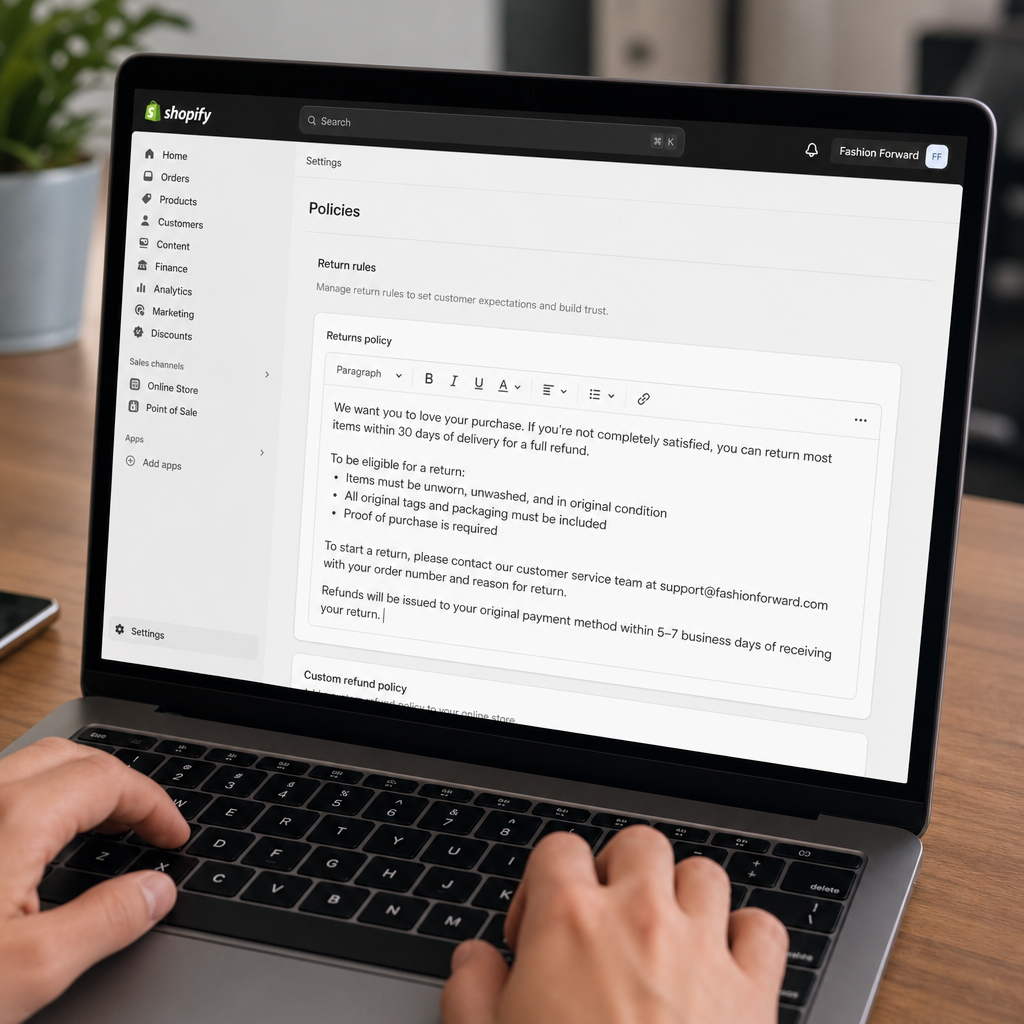
- Settings → Policies: Paste your full ACL-compliant returns policy into the “Refund policy” field. Shopify automatically links this in your checkout and footer.
- Site footer: Verify the “Refund policy” link appears in your footer navigation (Online Store → Navigation → Footer menu). Add it manually if it’s missing.
- Checkout page: Shopify’s checkout footer automatically shows links to your Refund policy, Privacy policy, and Terms of service. If you’re on Shopify Plus, you can edit the checkout.liquid template to add a brief ACL statement above the “Complete order” button — something like: “Your purchase is covered by Australian Consumer Law guarantees.”
- Product pages: Consider adding a brief “ACL-protected purchase” badge or a collapsible “Returns & Warranty” section on product pages for high-value items. The Shopify app product page conversion tools can help you build this without code.
Online Store Warranty Requirements Australia
Warranties and consumer guarantees are related but different concepts — and conflating them creates legal risk.
A voluntary warranty is something you offer on top of the ACL baseline (e.g., “12-month warranty against manufacturing defects”). You can set its terms. But you cannot use a voluntary warranty to restrict ACL rights — for example, saying “this warranty is your only remedy” is illegal because it attempts to exclude the ACL’s mandatory guarantees.
The ACL also governs extended warranties sold as add-on products. If you sell or recommend extended warranties (common in electronics), the ACL requires that you inform the customer of their existing ACL rights before they purchase — so they can make an informed decision about whether the paid warranty adds genuine value.
Spare Parts and Repair Facilities: A Note for Electronics and Appliance Dropshippers
Under Section 58 of the ACL, suppliers must take reasonable steps to ensure that spare parts and repair facilities are available for a reasonable time after purchase. This is a frequently overlooked obligation in the dropshipping space.
If you’re dropshipping electronics or appliances from overseas suppliers, you need to either: (a) confirm your supplier can provide spare parts and repairs to Australian customers, or (b) disclose clearly before purchase that spare parts may not be available locally and that repairs would need to be arranged internationally. Silence is not compliance. If a customer buys a $400 blender from your store and the motor fails at 18 months, they have ACL rights to repair — and your overseas supplier saying “not my problem” doesn’t extinguish your liability as the Australian-facing seller.

How to Comply With ACL for Online Businesses: A Practical Checklist
I’ve distilled the compliance work into a checklist you can run through today. Bookmark this section.
Policy Compliance
- ☐ Returns policy includes the full ACCC-recommended ACL guarantee statement (verbatim, as shown above)
- ☐ Policy does not contain “no refunds”, “exchange only”, or “sale items excluded” language
- ☐ Change-of-mind policy is clearly separated from ACL fault remedy policy
- ☐ BNPL dispute process is addressed for each provider you use
- ☐ Voluntary warranty does not claim to limit ACL rights
Display Compliance
- ☐ Returns policy is linked in the site footer (visible on all pages)
- ☐ Returns policy is linked at checkout (Shopify does this automatically via Settings → Policies)
- ☐ Total price including GST is displayed on product and cart pages
- ☐ ABN/ACN and contact details are accessible (About page or footer)
Operations Compliance
- ☐ Customer service team knows the difference between minor and major failures
- ☐ Partial refund process documented in Shopify (see two-step workflow above)
- ☐ Electronics/appliance supplier can confirm spare parts availability for Australia
- ☐ Dispute records kept for at least two years
Fair Trading Laws and State Overlap
The ACL is a uniform national law, administered in each state and territory by the relevant fair trading office — Consumer Affairs Victoria, NSW Fair Trading, Queensland Office of Fair Trading, and so on. In practice, if your store is based in Victoria and a customer in Queensland complains, either office can refer the matter to the other or to the ACCC.
For most online stores, you don’t need to worry about state-by-state variations — the ACL is the same across all jurisdictions. Where state law adds to the ACL (for example, some states have specific second-hand dealer regulations or specific rules for certain services), those additions would apply to the relevant transactions. But for standard product-based e-commerce, the federal ACL is your primary compliance framework.
If you want to go deeper on e-commerce legal compliance in Australia, the ACCC’s business resources page is the authoritative starting point. Their Advertising and Selling Guide is free, current, and written for business owners — not lawyers.
Key Takeaways
- The ACL applies to any online store selling to Australian consumers — location of the business is irrelevant
- “No refunds” and “sale items excluded” are illegal under Section 29 of the ACL
- For major failures, the consumer chooses the remedy; for minor failures, you do
- Change-of-mind returns are not required by the ACL — but keep this policy separate from your fault remedy policy
- BNPL providers like Afterpay and Zip have dispute mechanisms that can override your internal process if you don’t respond in time
- Electronics and appliance dropshippers have a specific spare-parts obligation under Section 58 of the ACL
- In Shopify: Settings → Policies is where you add your compliant returns policy; it auto-populates checkout and footer links
- The full ACCC-recommended guarantee statement must appear verbatim in your returns policy
Conclusion
ACL compliance is not optional, and the good news is that it’s not complicated once you know the rules. Most stores that are out of compliance aren’t trying to rip anyone off — they just copied a template that was wrong, or they didn’t know the law applied to them.
Take 30 minutes today: drop the template above into your Shopify policy settings, check your footer links are live, and read through your existing copy for any “no refunds” language. That’s it — you’ll be ahead of the majority of Australian online stores.
If you’re building out your store’s legal and operational foundation, check out our guide on Shopify store setup essentials and our breakdown of Australian e-commerce shipping policies — both of which feed into ACL compliance in ways most store owners overlook.
Have a specific ACL scenario you’re unsure about? Drop it in the comments below — I’m happy to walk through the analysis with you.
FAQ
Does Australian Consumer Law apply to my Shopify store if I'm based overseas?
Yes. If you sell goods or services to consumers in Australia, the ACL applies regardless of where your business is based or incorporated. A dropshipper operating from Singapore but marketing to Australian buyers is fully within ACL scope. The Competition and Consumer Act 2010 (Cth) covers the transaction, not the seller's location.
Can I have a 'no refunds on sale items' policy in Australia?
No. 'No refunds on sale items' is an illegal statement under Section 29 of the ACL. Sale items carry the same consumer guarantees as full-price products. A discounted price does not reduce a customer's right to a remedy for faulty or misdescribed goods. Remove this clause from your policy immediately.
Am I required to accept change-of-mind returns under Australian Consumer Law?
No. The ACL does not require you to accept returns when a customer simply changes their mind. Consumer guarantees only apply to faults, safety issues, or goods that don't match their description. You can have a 'no change-of-mind returns' policy — but it must be clearly displayed before purchase and kept separate from your fault remedy policy.
What is the mandatory ACL statement I need to include in my returns policy?
The ACCC recommends this verbatim: 'Our goods come with guarantees that cannot be excluded under the Australian Consumer Law. You are entitled to a replacement or refund for a major failure and compensation for any other reasonably foreseeable loss or damage. You are also entitled to have the goods repaired or replaced if the goods fail to be of acceptable quality and the failure does not amount to a major failure.'
How do I add my returns policy to Shopify to comply with ACL display requirements?
Go to Shopify Admin → Settings → Policies and paste your ACL-compliant returns policy into the 'Refund policy' field. Shopify automatically adds links to this policy in your checkout page footer and site footer navigation. For Shopify Plus stores, you can also add a brief ACL statement directly above the 'Complete order' button by editing the checkout.liquid template.
What are the penalties for displaying illegal refund policies in Australia?
Under the ACL, making false or misleading representations about consumer rights (including displaying 'no refunds' signs or policies) can attract penalties of up to $50,000 per contravention for individuals and $250,000 per contravention for companies. The ACCC publishes enforcement actions publicly, naming the businesses involved.
Do I need to provide spare parts for products I dropship from overseas?
Yes, if you sell electronics or appliances. Under Section 58 of the ACL, suppliers must take reasonable steps to ensure spare parts and repair facilities are available for a reasonable time after purchase. If your overseas supplier cannot provide this to Australian customers, you must disclose that clearly before purchase — silence does not protect you from liability as the Australian-facing seller.
