

If you’re trying to hire a Shopify developer in Australia, you’ve already discovered the problem: local rates are high, quality varies wildly, and going offshore carries legal risk most guides never mention. I’ve seen Australian e-commerce owners spend AUD $30,000 on a local agency, get a mediocre build, and still pay for fixes six months later. I’ve also seen them hire an offshore team for a quarter of the price and end up with a Privacy Act liability they didn’t know existed. Neither outcome is inevitable, but both are common when the decision is made without the full picture.
The Australian online shopping market reached AUD $60.8 billion in 2025, growing at 8.7% year-on-year according to IBISWorld. Australia now hosts approximately 150,000 active Shopify websites, ranking third globally behind only the US and UK. That growth has created a developer ecosystem that ranges from world-class to outright fraudulent — and Australian business owners are left navigating it without much honest guidance.
This guide fixes that. You’ll get real cost breakdowns with timelines attached, a decision-framework table, an explanation of what APP 8 actually means for your business, and a checklist for vetting any developer before you sign a contract. No generic advice. No hedging. Just what you need to make the right call for your specific situation.
The Three Models Defined: What Each One Actually Looks Like
Before comparing costs, it’s worth being precise about what these three models actually involve in practice. Most guides treat them as self-evident. They’re not.
Local Australian Agency
A local Shopify agency is an Australian-registered business (with an ABN) that employs or contracts a team of developers, designers, and project managers. They operate in your timezone, speak your commercial and legal language, and typically hold Shopify Partner status. When something goes wrong post-launch, there’s a real business entity you can call, email, or take to NCAT if needed.
A concrete example of what this looks like: a Melbourne-based fashion retailer with AUD $4M in annual revenue contracts a Sydney Shopify agency for a full Shopify Plus migration from Magento. The agency assigns a dedicated project manager, handles Afterpay integration, sets up Xero accounting sync, and configures Australia Post label printing. Total cost: AUD $45,000–$65,000 over 12–16 weeks. Expensive, but the retailer has recourse if deliverables are missed.
Australian Freelancer
An Australian Shopify freelancer is a sole trader or independent contractor working locally. They’re often ex-agency developers who’ve gone independent to earn more per hour with less overhead. They can be excellent value for scoped, defined projects — but they have a single point of failure. If they get sick, take another client, or simply disappear, your project stops.
A realistic scenario: a Brisbane supplement brand needs a custom Shopify theme with a subscription upsell integration. They hire a senior local freelancer at AUD $140/hr. The 80-hour project costs around AUD $11,200 — fast, quality work, direct communication. But when the brand later needs ongoing support and the freelancer moves to a full-time role, they’re back to square one.
Offshore Developer or Agency
Offshore means hiring developers based in countries like India, Pakistan, the Philippines, Eastern Europe, or Southeast Asia — either individual contractors through platforms like Upwork or Toptal, or dedicated offshore agencies. The cost differential is real: offshore Shopify developers typically charge USD $15–$40/hr (roughly AUD $23–$62/hr at current rates), compared to AUD $120–$180+/hr for senior Australian developers.
But offshore is not simply “cheaper Australian.” The skill range is enormous, timezone gaps create real delays, and Australia-specific integrations (Afterpay, Australia Post, GST logic, Xero) are frequently handled incorrectly by developers who’ve never worked in the Australian market. And there’s the Privacy Act issue, which we’ll cover in detail shortly.
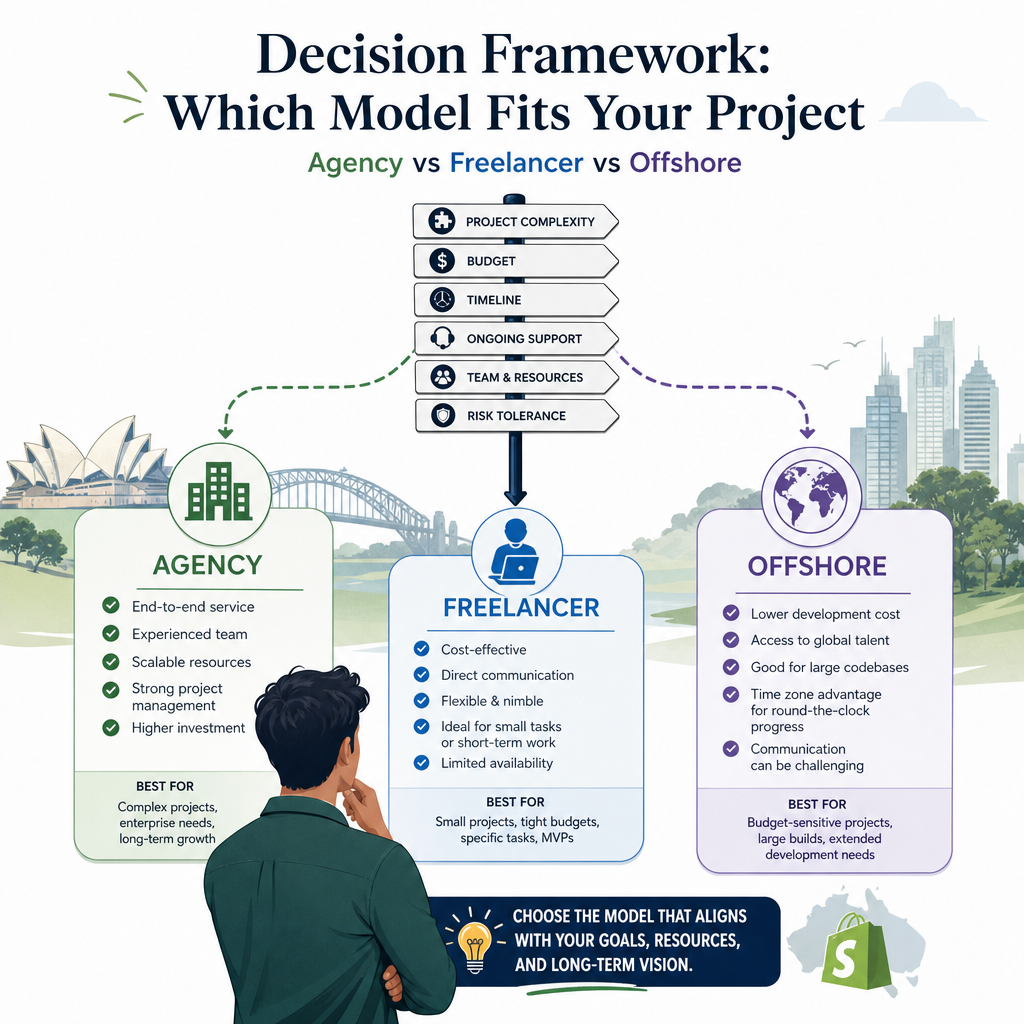
Decision Framework: Which Model Fits Your Project
Before diving into costs and compliance, use this table to orient yourself. No model is universally correct — the right choice depends on your project scope, budget, and risk tolerance.
Project Decision Framework
New Shopify store (basic theme, standard apps) | Budget: AUD $3,000–$8,000 | Model: Offshore developer or local freelancer | Timeline: 3–6 weeks
A simple store with a premium theme, standard Shopify apps, and basic product setup doesn’t require local expertise. A well-vetted offshore developer handles this competently.Custom Shopify theme or app integration | Budget: AUD $8,000–$25,000 | Model: Senior local freelancer or small local agency | Timeline: 6–12 weeks
Custom work with Australian-specific integrations (Afterpay, Australia Post) benefits from local knowledge. A freelancer is cost-effective if the scope is locked.Shopify Plus migration or full re-platform | Budget: AUD $25,000–$80,000+ | Model: Local agency or hybrid model | Timeline: 12–20 weeks
Complex migrations require coordinated teams, project management, and accountability. A reputable local agency or a hybrid model (local oversight + offshore delivery) is appropriate here.Ongoing maintenance and development retainer | Budget: AUD $2,000–$6,000/month | Model: Hybrid model or local agency retainer | Timeline: Ongoing
Retainer work suits a hybrid approach: local strategy and code review, offshore execution. This delivers the best cost-to-quality ratio over time.
Real Cost Breakdown: What You Actually Pay in 2024
Hourly rates are only part of the story. The total cost of a hiring decision includes revision cycles, communication overhead, post-launch fixes, and in the offshore case, potential compliance costs. Here’s what each model actually costs across common project types.
Local Australian Agency Rates
According to Naveck Technologies’ 2026 Australian web development cost guide, Sydney and Melbourne agencies command a 15–30% price premium over agencies in Brisbane, Perth, or Adelaide. Typical project costs from local agencies:
- Basic Shopify store setup: AUD $5,000–$12,000 (4–6 weeks)
- Custom theme development: AUD $12,000–$35,000 (8–14 weeks)
- Shopify Plus build with custom integrations: AUD $40,000–$100,000+ (14–22 weeks)
- Ongoing retainer (10–20 hrs/month): AUD $2,500–$6,000/month
These figures reflect work that includes Australian-market expertise: correct GST configuration, Afterpay and Zip Pay integration, Australia Post API setup, and Xero accounting sync. Getting these wrong post-launch costs additional money to fix — a cost that rarely appears in the original quote.
Australian Freelancer Rates
Freelancers charge by the hour or by fixed project scope. Hourly rates in 2024 range from AUD $70–$100/hr (mid-level) to AUD $130–$180/hr (senior, 5+ years Shopify experience). For a 60-hour custom integration project, that’s AUD $4,200–$10,800 depending on experience level.
The risk with freelancers isn’t usually quality; it’s availability and continuity. A fixed-scope contract with clearly defined deliverables, payment milestones, and code ownership clauses dramatically reduces this risk. More on contract protection later.
Offshore Developer Rates and the Hidden Cost Arithmetic
Offshore developers on platforms like Toptal or Upwork typically charge USD $20–$60/hr for Shopify work (USD $15–$25 for basic builds, USD $40–$60 for senior developers with platform expertise). At face value, a 100-hour project costs USD $2,000–$6,000 versus AUD $13,000–$18,000 locally. The saving looks obvious.
But here’s the hidden cost arithmetic most guides skip:
- Revision cycles due to miscommunication: Add 20–40% to estimated hours. A 100-hour project becomes 130 hours. At USD $30/hr, that’s an extra USD $900.
- Timezone management overhead: Your time spent on async communication, reviewing work overnight, and re-briefing adds 5–10 hours of your own time per week on a major project. Value your time at AUD $100/hr, and a 12-week project costs you AUD $6,000–$12,000 in personal overhead.
- Australia-specific fixes post-launch: GST misconfiguration, broken Afterpay checkout flows, or Australia Post label errors are common with offshore teams unfamiliar with the Australian market. Budget AUD $2,000–$5,000 for post-launch remediation.
- Privacy Act compliance setup (if applicable): Engaging an Australian privacy lawyer to draft a data processing agreement with your offshore developer costs AUD $1,500–$3,500. Skip this, and you’re carrying the risk yourself — see the compliance section below.
A “USD $4,000 offshore project” realistically lands at AUD $12,000–$18,000 all-in when you account for these costs. That’s not a reason to avoid offshore — but it is a reason to price it honestly before you decide.

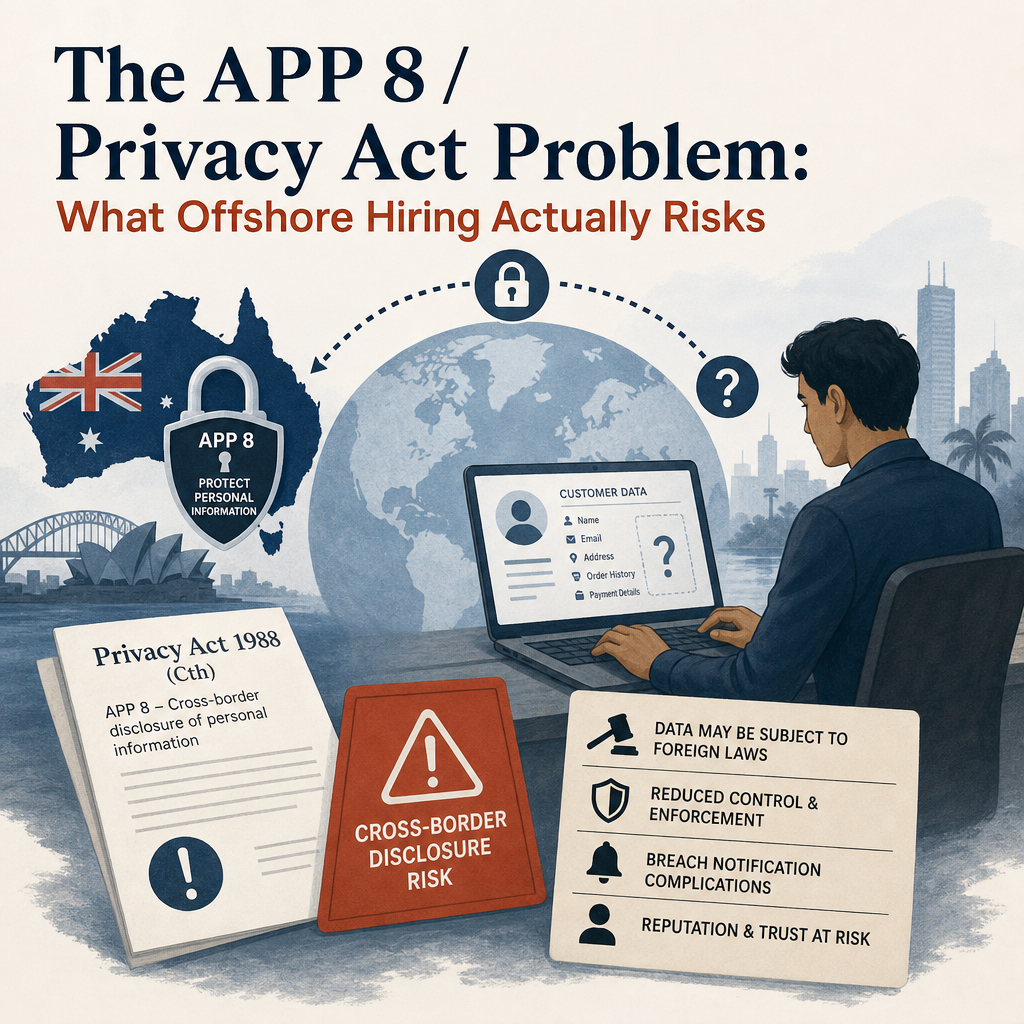
The APP 8 / Privacy Act Problem: What Offshore Hiring Actually Risks
This is the section most Australian hiring guides skip entirely. It’s also the section that matters most if your Shopify store collects any personal information, which almost every store does, including names, email addresses, shipping addresses, and payment history.
Under Australia’s Privacy Act 1988, the Office of the Australian Information Commissioner (OAIC) is explicit: when you share personal information with an offshore developer or agency, you remain legally responsible for how that data is handled. Liability follows the data, not the contract. If your offshore developer in India or Eastern Europe mishandles, leaks, or improperly stores your customers’ personal data, the OAIC can hold you, the Australian business, accountable.
APP 8 (Cross-border Disclosure of Personal Information) was strengthened by the 2024 Privacy Act reforms and applies to every offshore engagement where your developer can access customer data, including viewing your Shopify admin, pulling order exports, or accessing your customer database for debugging.
What the Liability Exposure Actually Looks Like
Under the current framework, serious or repeated privacy breaches can attract civil penalties of up to AUD $50 million for large organisations or, for smaller businesses, the greater of AUD $2.5 million or three times the benefit obtained from the breach. For a business turning over AUD $1–$5M annually, a regulatory investigation, even without a formal fine, costs legal fees, management time, and reputational damage that can be devastating.
More immediately: if an offshore developer copies customer data, stores it insecurely, or uses it for purposes beyond your project, you have very limited contractual recourse across international borders. Most offshore contracts are governed by local law in the developer’s country. Enforcing an Indian contract from Australia is expensive, slow, and often futile.
The 3-Step APP 8 Compliance Checklist
If you’re engaging an offshore Shopify developer and they will access personal customer data, follow these three steps before sharing any data:
- Conduct a reasonable assessment. Before engaging the offshore developer, assess whether the country they operate in has privacy laws that offer “substantially similar” protection to Australia’s Privacy Act. The OAIC provides guidance on this assessment. Countries like Germany (GDPR) and Canada (PIPEDA) generally pass this test. Many others do not. If you cannot make this determination confidently, proceed to step two regardless.
- Execute a Data Processing Agreement (DPA). A DPA is a contract that binds your offshore developer to specific obligations: how they can use the data, where they can store it, how they must protect it, and what happens in the event of a breach. This agreement must be governed by Australian law (or include an Australian-law clause) to be meaningful. Have an Australian solicitor draft or review this. Budget AUD $1,500–$3,500 for this step. It is not optional if you’re sharing customer PII.
- Minimise the data you share. Never export your full customer database to an offshore developer unless it’s strictly necessary. For most development and debugging work, anonymised or synthetic data works just as well. Strip names, emails, and payment details from any data exports used for testing. Use Shopify’s development store features rather than sharing production store access where possible.
If you follow these three steps, your compliance exposure is substantially reduced. If you skip them as most businesses hiring offshore do, you’re carrying a legal risk that very few Australian e-commerce owners have actually priced into their “cheap offshore build.”
The Fake Local Agency Trap: How to Detect It
One of the most common traps in Australian Shopify hiring is the “fake local agency”, an Australian-branded business with a Sydney or Melbourne address, professional website, and local phone number that does all actual development work through an undisclosed offshore team. This isn’t inherently wrong if disclosed, but most don’t disclose it. The problems this creates:
- You pay local agency rates (AUD $150–$200+/hr equivalent) for offshore execution quality
- Communication goes through a local account manager who doesn’t understand the technical work
- Your customer data is shared offshore without your knowledge or consent, a direct APP 8 violation you’re liable for
- When things go wrong, the local entity has no technical capacity to fix them quickly
Five Detection Signals to Check Before You Sign
- Check the ABN. Every legitimate Australian agency has an Australian Business Number registered with the ATO. Search it on the ABN Lookup. Check that the registered business name and address match what’s on their website. A recently registered ABN (less than 12 months old) for a company claiming years of experience is a red flag.
- Check their Shopify Partner Directory listing. The official Shopify Partners Directory lists verified agencies and freelancers. A legitimate Shopify agency should appear here with a profile, reviews, and verified store count. No listing, or a listing with zero reviews, warrants deeper scrutiny.
- Verify LinkedIn team profiles. Search the agency name on LinkedIn and look at the team. Are the developers’ profiles Australian-based with Australian work history? Or are there 40 staff members based in Ahmedabad with a single Australian director? Either model can work, but if they’ve presented themselves as a “local Australian team,” the LinkedIn reality tells you what you’re actually buying.
- Check the email domain and invoicing. Legitimate Australian agencies invoice with an Australian ABN and GST. If you receive a quote that doesn’t include GST (for a business that should be GST-registered), or if email domains don’t match the business name, ask directly before proceeding.
- Ask directly about data handling. Say: “Which team members will have access to our Shopify admin and customer data, and where are they based?” A legitimate local agency will answer this clearly. A fake local agency will deflect, change the subject, or give vague answers about “our team.” Either way, you now know what you’re dealing with.
For verified agency reviews based on real client feedback, Clutch.co’s Australia Shopify agency rankings are the most reliable source. Clutch verifies client reviews through a direct interview process; they’re harder to game than Google Reviews or testimonials on an agency’s own website.
Australian-Specific Integrations: Where Offshore Teams Consistently Fall Short
This is a practical point that cost comparisons rarely cover. The Australian e-commerce ecosystem has a specific set of integrations that every serious Shopify store needs and that developers who haven’t worked in the Australian market frequently get wrong.
- Afterpay and Zip Pay: Buy-now-pay-later is mainstream in Australia in a way it isn’t in most other markets. Configuring Afterpay correctly in Shopify, including widget placement, eligibility thresholds, and checkout flow, requires familiarity with how Australian consumers expect it to work. Offshore developers regularly implement it technically but incorrectly from a UX and conversion standpoint.
- Australia Post API integration: Real-time shipping rate calculation and label printing via the Australia Post API is standard for Australian retailers. The API has specific requirements around weight/dimension data, product categories, and account credentials that vary by shipping contract. Offshore teams unfamiliar with AusPost frequently misconfigure this, leading to incorrect shipping rates at checkout.
- Xero accounting sync: Most Australian SMEs use Xero for accounting. Shopify-Xero integration (via apps like Bold Commerce or native connectors) needs to handle Australian tax codes, GST-inclusive pricing, and AUD currency correctly. Getting this wrong creates accounting reconciliation problems that cost your bookkeeper hours to fix every month.
- GST configuration: Australian GST (10%) has specific rules around how it appears in checkout, how it’s calculated for international orders, and how it’s reported. Shopify’s GST configuration is not automatic; it requires deliberate setup. Many offshore developers configure it based on their own country’s tax rules, which are different.
If any of these integrations matter to your business, budget for testing by someone who knows the Australian market, even if you hire offshore for the core build.
The Hybrid Model: Local Oversight with Offshore Execution
The hybrid model is the most underreported option in Australian Shopify hiring. It works like this: you engage an Australian developer or small agency in a senior/oversight role, architecture decisions, code review, brief writing, and client communication, while an offshore team handles the bulk of development execution. The Australian developer effectively acts as a technical director for an offshore team.
Done well, this model reduces total project costs by 40–60% compared to a fully local agency, while preserving the accountability, timezone alignment, and Australian-market expertise that offshore-only engagements lack. The Australian anchor takes responsibility for the output. They own the relationship with you and the quality of the deliverable. They manage the offshore team directly.
For a Shopify Plus build that would cost AUD $60,000 with a local agency, the hybrid model might look like:
- Australian technical director: 40 hours at AUD $160/hr = AUD $6,400
- Offshore development team: 200 hours at USD $30/hr = approx. AUD $9,300
- QA and testing (offshore): 40 hours at USD $20/hr = approx. AUD $1,240
- Total: approx. AUD $17,000–$22,000 vs. AUD $60,000 local-only
The hybrid model also handles the APP 8 issue more cleanly: the Australian technical director is the one with offshore developer access to your Shopify data, and they hold contractual responsibility for managing that access appropriately under Australian law.
If you’re building a Shopify Plus store or planning a complex migration, the hybrid model deserves serious consideration before you commit to a full local agency quote.
Protecting Yourself After the Project: Code, IP, and Continuity
Most hiring guides end at the point of signing a contract. But post-project risk is where Australian e-commerce owners get hurt most often, and it’s entirely preventable with the right contractual protections in place upfront.
Code Ownership
In Australia, the default under copyright law is that the creator owns the work, not the client who paid for it, unless a contract explicitly transfers ownership. If your contract doesn’t include a clause assigning intellectual property rights to you upon final payment, your developer or agency legally owns your custom theme code. This matters if you want to switch developers later or sell your business.
Your contract should state: “Upon receipt of final payment, all custom code, theme files, and associated intellectual property developed for this project are assigned in full to [your business name].” Have an Australian solicitor review any contract that doesn’t include clear IP assignment language.
Continuity and Access
Before a project begins, ensure you have or will receive upon completion full admin access to your Shopify store, your theme code in a repository you control (GitHub or Bitbucket), API credentials for all integrations, and documentation for any custom configurations. If a freelancer disappears or an offshore agency closes, you should be able to hand the project to a new developer without starting from scratch.
Ongoing Support Agreements
If you’re relying on a freelancer for ongoing support, have a written support agreement that defines response times, what’s covered, and what happens if they’re unavailable. For mission-critical stores, a retainer with a local agency or a hybrid arrangement gives you more protection against single-point failure than a handshake arrangement with an individual developer.
For more on structuring ongoing Shopify store maintenance and support, consider what level of post-launch coverage your business actually needs before you choose a hiring model.
Vetting Checklist: Before You Hire Any Shopify Developer in Australia
Use this checklist regardless of which model you’re considering. It takes 30–60 minutes and can save you tens of thousands of dollars.
- Verify their Shopify Partner status in the official directory. Check store count, reviews, and specialisations.
- Check ABN registration via ABN Lookup. Confirm GST registration if they’re billing more than AUD $75,000/year.
- Review actual Shopify stores they’ve built. Don’t accept screenshots — ask for live URLs and test them on mobile. Check load speed using Google PageSpeed Insights.
- Ask specifically about Australian integrations they’ve implemented: Afterpay, Australia Post, Xero, GST. Ask for an example from a previous client.
- Confirm who will actually do the work. If it’s an agency, ask which team members will be assigned and where they’re based. For offshore, ask about timezone overlap for communication.
- Review contract terms for: IP assignment, payment milestones tied to deliverables, termination clauses, and data handling obligations (for offshore).
- Check Clutch.co or Google Reviews for verified client feedback. Contact one or two references directly — any serious agency will provide them.
- For offshore engagements: execute a Data Processing Agreement before sharing any customer data or Shopify admin access.
If you’re looking at additional developer vetting resources, the above checklist covers the Australian-specific requirements that generic hiring guides omit.
Key Takeaways
- There is no single “best” model; the right choice depends on your project scope, budget, and how much Australian-market expertise your integration requirements demand.
- Offshore is not simply cheaper. When you add revision cycles, timezone overhead, post-launch fixes, and legal compliance costs, the true cost is often 60–80% of a local freelancer’s rate — with more risk.
- APP 8 is not optional. If your offshore developer accesses customer personal data, you need a Data Processing Agreement and a reasonable assessment of their country’s privacy laws. The OAIC holds you responsible regardless of what your contract says.
- The hybrid model delivers the best cost-to-quality ratio for projects above AUD $15,000. Local oversight, offshore execution, and a single accountable Australian contact covers most of the risk.
- Fake local agencies are a real problem. Verify ABN, Shopify Partner status, LinkedIn team profiles, and GST-registered invoicing before signing anything.
- Protect your IP from day one. Make sure your contract includes explicit IP assignment language and that you control access to your own store code and integrations.
Conclusion
Hiring a Shopify developer in Australia is genuinely more complex than hiring in most other markets. The legal obligations around data handling, the specific integrations Australian consumers expect, and the prevalence of misleading “local” agencies all make it a decision that rewards careful research over speed.
The framework in this guide gives you what you need to make that decision clearly. Define your project scope, match it to the right model using the decision table, verify any developer against the vetting checklist, and if you’re going offshore — get the legal protections in place before you share a single customer record.
I’m Prajosh VM, a Shopify developer with direct experience building and advising on stores in the Australian market. If you’re working through this decision and want a direct conversation about what your specific project needs, reach out for a consultation. No sales pitch, just an honest assessment of what approach fits your situation.
And if this guide helped you think through the decision more clearly, share it with another Australian e-commerce owner who’s navigating the same question. The more informed buyers there are in this market, the better the outcomes for everyone.
FAQ
How much does it cost to hire a Shopify developer in Australia in 2024?
Local Australian Shopify developers charge AUD $70–$180+/hr depending on experience level, with full project costs ranging from AUD $5,000 for a basic store to AUD $100,000+ for a Shopify Plus build. Offshore developers charge USD $15–$60/hr, but true all-in costs including revisions, communication overhead, post-launch fixes, and compliance setup are typically 60–80% of a comparable local rate.
Does Australia’s Privacy Act apply when I hire an offshore Shopify developer?
Yes. Under APP 8 of Australia’s Privacy Act 1988, you remain legally responsible for how an offshore developer handles your customers’ personal data — even after it leaves Australia. If your offshore developer accesses Shopify customer data, you should execute a Data Processing Agreement, assess privacy protections in their country, and minimise the personal data you share. Non-compliance can result in significant OAIC penalties.
What is the hybrid model for Shopify development and is it worth it?
The hybrid model uses a senior Australian developer or small local agency for strategy, architecture, and oversight, while an offshore team handles execution. It typically reduces project costs by 40–60% compared to a fully local agency while preserving accountability, Australian-market expertise, and timezone availability. It’s particularly effective for projects above AUD $15,000 in scope.
How do I spot a fake local Shopify agency in Australia?
Check their ABN on the ATO’s ABN Lookup tool, verify their listing in the official Shopify Partners Directory, and review LinkedIn team profiles to confirm actual team locations. Ask directly which team members will access your store and where they’re based. Legitimate local agencies provide GST-registered invoices and answer data-handling questions transparently.
Can offshore Shopify developers handle Australian integrations like Afterpay and Australia Post?
They can attempt it, but offshore developers unfamiliar with the Australian market frequently misconfigure Afterpay checkout flows, Australia Post API shipping rates, Xero accounting sync, and GST tax settings. Budget for post-launch testing by someone with Australian e-commerce experience, or specify these integrations explicitly in your brief and require working demonstrations before final payment.
Should I hire a Shopify freelancer or an agency for my Australian store?
For scoped, well-defined projects under AUD $20,000, a senior local freelancer often delivers better value than an agency — lower overhead, direct communication, and comparable skill. For complex builds, Shopify Plus migrations, or ongoing retainer work where team continuity matters, a local agency or hybrid model provides better protection against single-point failure.
How do I protect my Shopify store code and IP when working with a developer?
Include an explicit IP assignment clause in your contract stating that all custom code transfers to you upon final payment — Australian copyright law defaults to the creator owning the work otherwise. Ensure you receive full Shopify admin access, theme files in a repository you control, and documentation for all integrations before closing the project.
